
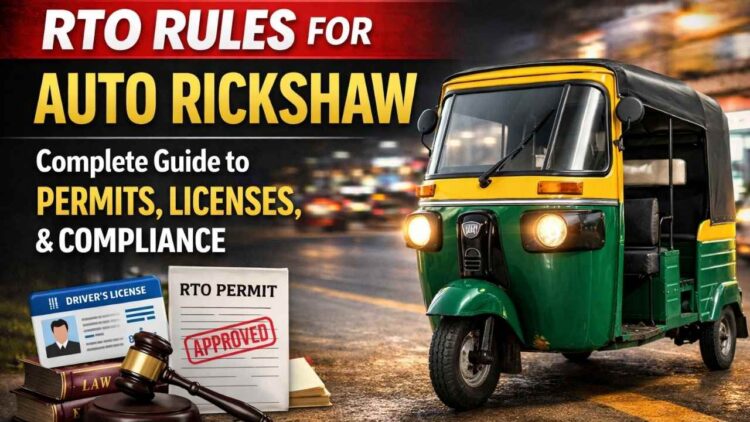
Auto rickshaws play an important role in public transportation in India, not only in cities but also in rural areas. It is essential for auto rickshaw drivers and owners to strictly follow RTO rules to ensure not only the safety of passengers but also to avoid any problems themselves.
In India, RTO rules for the auto rickshaws come under the Motor Vehicle Act of 1998, which includes license, registration, insurance, pollution control, fare meter, driver conduct and uniform, passenger and road safety, vehicle condition, and route and area restrictions.
RTO Rules for Auto Rickshaws
The RTO rules for the auto rickshaws in India are made to ensure road safety and also to ensure that the driver or owner does not face any problem with compliance. We have listed all the RTO rules of auto rickshaws below.
- To drive an auto rickshaw on a public road, it is necessary that the driver have a commercial driving license and have passed a driving test as well as a basic traffic rule knowledge exam; it is also mandatory for the vehicle to have a PSV badge.
- It is necessary that the auto rickshaw is registered with the nearest RTO, and a valid permit is available, which can be a City Permit / Contract Carriage Permit.
- It is compulsory that the auto rickshaw has third-party insurance and a valid fitness certificate is available.
- Pollution Under Control (PUC) Certificate is also an essential document that is mandatory to be available.
- Every autorickshaw must be fitted with a government-approved meter, which should probably be fitted and calibrated according to RTO norms.
- It is mandatory to wear government-approved dress, either khaki or the dress specified by the government. And it has to be ensured that the ID card and license details are clearly visible.
- It is illegal to carry more passengers than the seating capacity, and one cannot be refused service without a valid permit. It is most important that traffic rules are followed properly and there is no overspeeding or signal jumping.
- The mechanical condition of the auto rickshaw must also be improved; it must be ensured that the lighting and braking work properly, and any unapproved modification is not allowed.
- It is important for the driver to be aware of the no-permit zones and ensure that he/she drives the vehicle only within his/her permit area.
Overall, if we look at the RTO rules for auto rickshaws, then it is mandatory to have a driving license (commercial), RC (registration certificate), permit copy, insurance certificate, PUC certificate, and fitness certificate. Along with this, it is also necessary to follow all the traffic rules.
What if someone does not follow the RTO rules for an auto rickshaw?
If an auto-rickshaw driver, knowingly or accidentally, does not follow the RTO rules, they face penalties, and in some cases, license and permit cancellations may also occur. In some cases, the vehicle may even be seized. We have shared details regarding the penalty, cancellation, and seizure below.
Penalties
- Driving without a valid license: ₹5,000
- No permit / invalid permit: ₹10,000+
- No insurance: ₹2,000 (first), ₹4,000 (repeat)
- No PUC certificate: ₹1,000 (first), ₹2,000 (repeat)
- Overloading passengers: ₹1,000+
- Fare refusal / overcharging: ₹500 to ₹2,000
- No fitness certificate: ₹5,000
- No uniform / no badge: ₹100 to ₹500
- Traffic violations (signal jump, rash driving, etc.): ₹500 to ₹5,000
- Illegal vehicle modifications: ₹5,000+
- Operating outside permit area: ₹2,000 to ₹5,000
License/Permit Cancellation
- Repeated traffic violations
- Driving without a valid permit/fake permit
- Drunk driving or drug use
- Misconduct with passengers
- Overcharging or meter tampering
- Involvement in criminal activities
- Operating an unfit vehicle (no fitness certificate)
- Fake or forged documents
- Continuous rule violations despite penalties
Vehicle Seizure
- No valid driving license
- No permit / expired or fake permit
- No registration (RC)
- No insurance
- Repeated traffic violations
- Drunk driving
- Overloading passengers
- Illegal modifications
- Operating outside the permit area
- Involvement in illegal/criminal activities
The RTO rules for auto rickshaws that we have learned are as per the MVA of 1998. Apart from this, the state authorities have also made some different rules in their respective states; compliance with them is also necessary, so it is important to know that if there are some other rules in your area apart from these, then make sure to follow them as well because in that situation you can be penalized.