
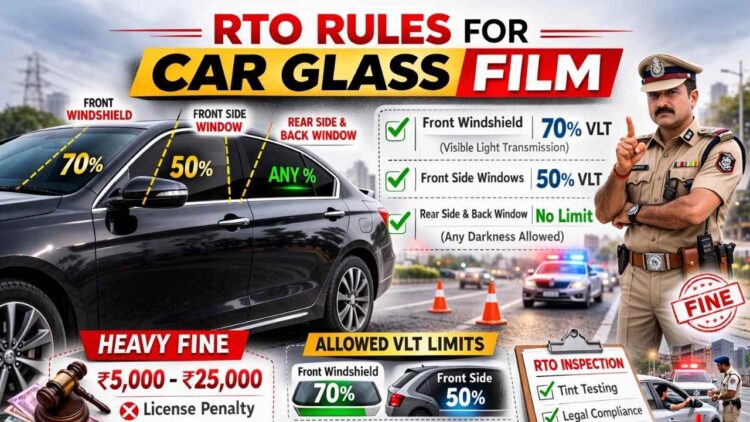
Many people install glass films in their cars for heat reduction, UV protection, privacy safety (shatter protection), clear reduction, and aesthetics (style), but without knowing the RTO rules, many times they have to pay heavy penalties and face other legal consequences.
If you are also thinking of installing a glass film on your car, no matter what the purpose behind it, then it is important for you to first be aware of the RTO rules because if you are found violating them, you may have to face problems.
Here, we have discussed in detail the RTO rules for car glass film 2026. By reading the article thoroughly, you can know what the rules and laws related to car glass film in India are, what consequences one may have to face for violating them, and much more.
RTO Rules for Car Glass Film 2026
The RTO rules related to car window films in 2026 fall under the Central Motor Vehicles Rules, the Motor Vehicles Act, and the Supreme Court’s 2012 Avishek Goenka v. Union of India judgment. These rules have been made keeping public safety in mind.
If a car owner violates any of the rules related to window films, he/she not only faces a penalty but also has to face a legal case in some situations. Therefore, it is important for you not to install any type of film on your car windows without being aware of all the rules.
What are the RTO rules for car glass film in 2026?
We have shared all the RTO rules related to car window film below. You can read the following points to understand whether installing car window film is allowed or not.
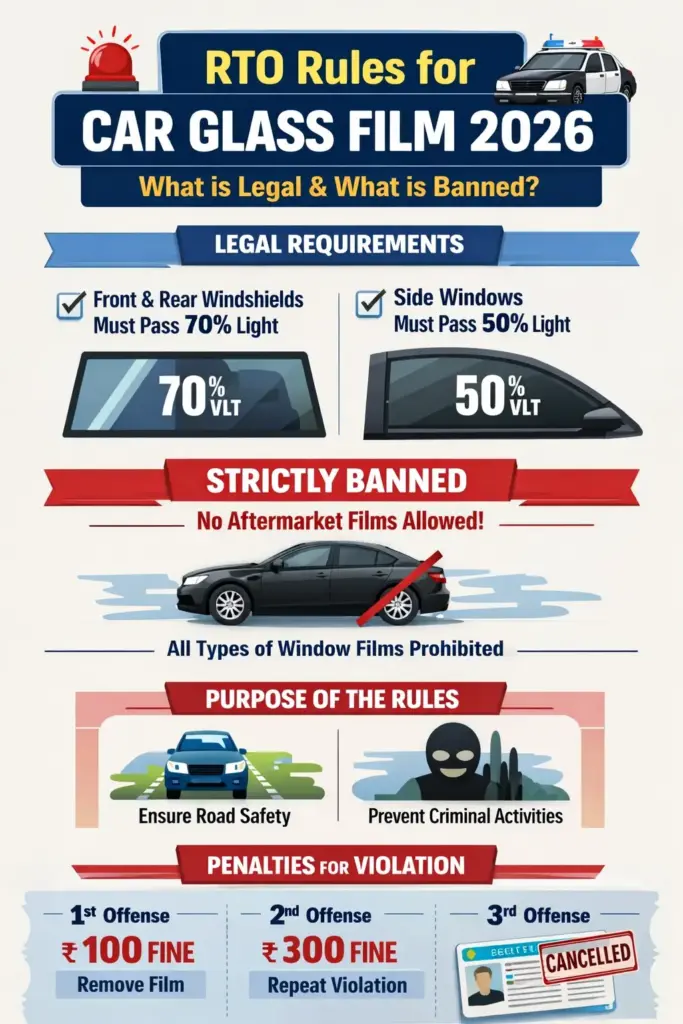
- As per Rule 100 of the Central Motor Vehicles Rules (CMVR), under the Motor Vehicles Act, the front and rear windshields should pass at least 70% of the light, while the visible light transmission requirement for side windows is at least 50%. The objective is to provide proper visibility to the driver and ensure road safety.
- The Supreme Court judgment in Avishek Goenka vs. Union of India, 2012, clearly states that the use of aftermarket films and materials is strictly prohibited even if they do not have visible light transmission (VLT). It means that the use of any type of window film is strictly prohibited even if it does not reduce visible light transmission requirements.
If we look at the RTO rules related to car window films, it clearly states that no type of film or anything else can be used on the front or rear windshield or side windows of the car, whether its purpose is to get comfort, privacy, or anything else.
Only company-fitted windshields and windows can be used in the vehicle, and they should also meet the Visible Light Transmission (VLT), which is 70% for front and rear windows and 50% for side windows, as we have mentioned above.
What’s the purpose of the RTO rules for car window film?
The RTO rules for car window films have a clear purpose of ensuring road safety, and for this it is very important that the driver gets clear visibility. Lack of clear visibility often leads to accidents, especially during nighttime or in bad weather conditions.
The sole purpose of these RTO regulations is not only road safety but also to enable law enforcement to easily identify vehicle occupants and enforce traffic rules. The use of window films is also prohibited to prevent criminals from using the vehicle for illegal purposes.
What if someone violates the RTO rules for car window film?
If you are found to have any type of window film installed in the car, a penalty of ₹100 will be imposed, and the film will be removed on the spot.
Note that in case of repeat violence, the penalty is ₹300, and if you are found violating the rules for the third time, again you will be fined ₹300, and your driving license can also be cancelled.