
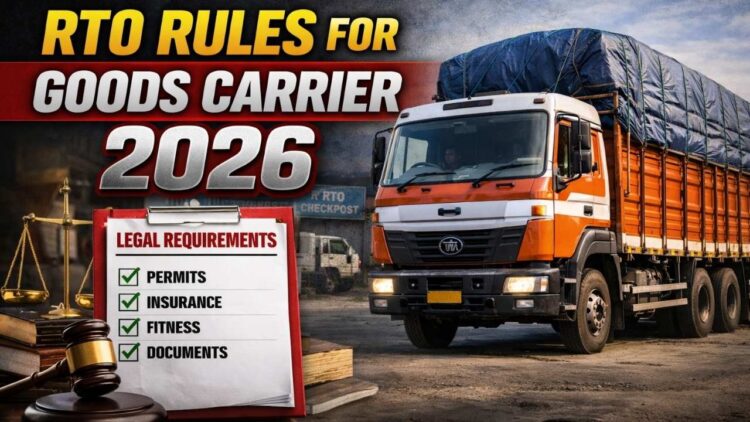
Commercial vehicles that carry only goods are called goods carriers. The RTO rules for them are slightly different from passenger vehicles. If you are the owner or driver of a goods carrier, it is important for you to be aware of them so that you do not have to face any problem in the future.
For any goods carrier to ply on public roads, it is necessary that all the rules that come under the Motor Vehicles Act of 1998 are followed. Here, we have discussed what the RTO rules are for goods carriers and what consequences you may have to face if you violate them.
RTO Rules for Goods Carrier
Goods carriers are known as Category N vehicles in India. They are divided into three categories under the Central Motor Vehicles Rules, 1989, namely N1, N2, and N3. You can find the differences between these three from the below.
- N1: It includes goods carriers with a gross vehicle weight (GVW) of 3.5 tonnes or less.
- N2: It includes goods carriers with a gross vehicle weight (GVW) of more than 3.5 tonnes and less than or equal to 12 tonnes.
- N3: It includes all goods carriers with a gross vehicle weight (GWC) of more than 12 tonnes.
The RTO rules for these three categories of goods carriers are completely common, and the consequences for violating them are also the same. Whether you are a driver or owner of any of these categories of good carriers, read the article thoroughly and be aware of the rules.
What are the RTO rules for Goods Carrier?
The following are the RTO rules for goods carriers in 2026. It is mandatory to follow the following rules and regulations for their operation on public roads.
- Your goods carrier should be registered as a transport vehicle with the nearest RTO.
- If the GVW of your goods carrier is more than 3 tonnes, then it is necessary that you have the required permit; a state permit is required to operate within the state, and a national permit is required to go anywhere in the country.
- If you own a good carrier, then it is important for you to ensure that the driver of your vehicle has a valid heavy motor vehicle (HMV) driving license.
- Your vehicle must have third-party insurance, and the load must not exceed the Gross Vehicle Weight (GVW), which includes vehicle weight, cargo, driver, and fuel.
- You must have retro-reflective tapes (white front, red rear, and yellow sides) on your goods carrier; this is so that vehicles coming from the front get clear nighttime visibility and accident-like situations do not arise.
- It is mandatory to have a valid fitness certificate and pollution under control (PUC) certificate for your Good Carrier.
Keep in mind that the fitness certificate is renewed every 2 years until the vehicle is 8 years old. After 8 years, annual renewal is mandatory. Talking about the PUC certificate, its renewal is required annually if the vehicle has emissions BS-IV & BS-VI and half-yearly if the emission is pre-BS IV.
The maximum GWV for N1, N2, N3 (rigid truck), and N4 (articulated trailer) is 3.5 tonnes, 12 tonnes, 49 tonnes, and 55 tonnes, respectively; anything over it will be considered overweight.
In UP, the State Transport Authority is directed to install Vehicle Location Tracking Devices (VLTD) and panic buttons in all commercial vehicles, including goods carriers, before April 2026.
What if anyone violates the RTO rules for goods carriers?
If you violate any RTO rule for a goods carrier, you could face fines, challans, or penalties; vehicle seizure; suspension or cancellation of your permit; and legal action. Details regarding fines and other consequences are as follows:
| Offence | Fine (1st Offence) | Repeat Offence |
| Overloading (Sec 194) | ₹20,000 + ₹2,000 per extra tonne | Higher fine |
| No Permit (Sec 66/192A) | ₹10,000 | ₹10,000+ |
| Expired / No Fitness (Sec 56/192) | ₹5,000 | ₹10,000 |
| No Insurance (Sec 146/196) | ₹2,000 | ₹4,000 |
| No Driving Licence (Sec 3/181) | ₹5,000 | ₹5,000 |
| Allowing Unlicensed Driver (Sec 5/180) | ₹5,000 | ₹5,000 |
| Driving Without RC (Sec 39/192) | ₹5,000 | ₹10,000 |
| Carrying Passengers in Goods Vehicle | ₹5,000+ | Higher fine |
| Over Speeding the Goods Vehicle | ₹2,000 to ₹4,000 | Higher fine |
| Dangerous Driving (Sec 184) | ₹5,000 | ₹10,000 |
| No Pollution Certificate (PUC) | ₹10,000 | ₹10,000 |
| Disobeying Traffic Signal | ₹5,000 | ₹5,000 |
In case of overloading, the vehicle is stopped until the extra load is removed; not having the required permit or having no valid fitness certificate or PUC certificate may result in vehicle seizure; disobeying traffic signals repeatedly may result in suspension of license; and dangerous driving may put you in jail.