
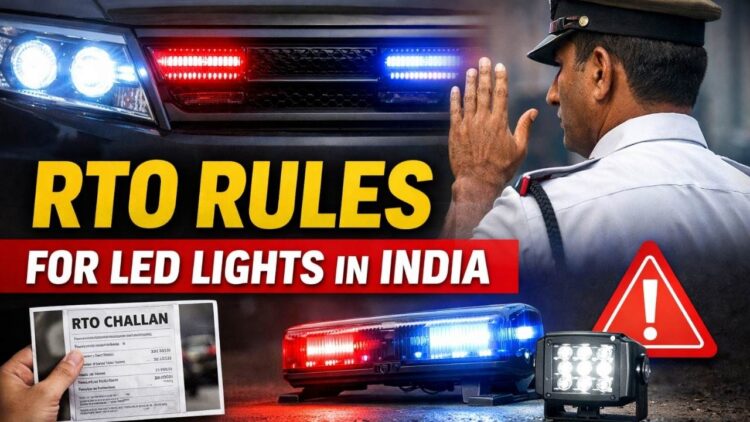
It’s normal to have an obsession with vehicle honors LED lights, as they not only enhance your car’s road presence but also give it a premium feel. If you are considering installing LED lights on your bike, car, or any other vehicle, it’s essential that you are aware of the RTO rules.
Here, we’ve discussed in detail the RTO rules for LED lights in India. By reading the article in full, you can learn whether installing LED lights in the vehicle is allowed in 2026, what could happen if someone is found violating the RTO rules and regulations, and much more.
RTO Rules For LED Lights In India
In India, RTO rules related to LED lights come under the Motor Vehicle Act of 1988. Many people have this question: whether they can install LED lights in their working bike or not. There is no simple answer to this. If the LED lights are installed at the time of purchase of the bike, then there is no problem, but in case of getting them installed separately, there are some rules that are very important to follow.
What are the RTO rules for LED lights in 2026?
It is very important to follow the rules related to LED lights for vehicles, which we have shared below.
- There is no problem with factory-fitted LED lights in vehicles if they fall under the Central Motor Vehicle Rules and automatic industry standards, and the rules for aftermarket LED lights are slightly different; they cannot be used unless they are certified and conform to pattern, intensity and type approvals.
- It is important that the LED lights installed in the vehicle meet the prescribed beam patterns and brightness limits so that the driver of the vehicle coming from in front does not experience glare and discomfort.
- If you are going to replace your car’s headlights with LED lights, then you will have to ensure that their wattage and lumens are within the limit, which is an average of 55–60 W per lamp.
- You cannot have any type of high-intensity auxiliary LED bars, strobe or flashing lights, or colored lights (blue, red, or green) on the front of your vehicle; these are strictly prohibited.
- If you are making structural changes to your vehicle to install LEDs, then first you will have to get the approval of the RTO. Doing so without approval will be considered illegal, and you may have to pay penalties and face other problems as well.
- The LED light fitted in the vehicle should have both high beam and low beam, and it is mandatory that if any vehicle is coming from the front, then the high beam should be dimmed; doing so is necessary for safety because high beam light can cause problems for the drivers of the oncoming vehicles, due to which things like accidents happen.
- You can install aftermarket LEDs in your car or bike if their brightness or lumen is 2,000-3,000 lumens in low and high beam positions; white and yellow lights are also allowed in color temperature, but it should be 5000-6000 K.
What if anyone violates RTO rules for LED lights in India?
If you violate the RTO rules related to LED lights, then in this situation you can be fined, which is ₹500. In case of a repeat offense, the challan amount will increase to ₹1500. One more thing you should know is that illegal and extra lights will be removed on the spot from the vehicle.
And if such LED lights are found installed in your vehicle that do not meet the Central Motor Vehicle Rules or Automotive Industry Standards, then in such a situation your registration can also be cancelled, and there may be a problem in getting a fitness certificate also.