
Helmets are safety equipment for two-wheelers such as bikes, motorcycles, and scooters, which helps in saving people’s lives. If you have recently bought a two-wheeler and are interested in knowing the RTO rules related to helmets in 2026, then you have come to the right place.
Here, we have discussed in detail the RTO rules for helmets in 2026; by reading this article, you will get to know if wearing a helmet is mandatory for all occupants of a two-wheeler, what kind of helmet it should be, and what happens if one violates the rule. Stay tuned till the end so that you do not miss any important point.
RTO Rules for Helmets in 2026
There is a lot of confusion among two-wheeler riders regarding helmets: whether their use is mandatory all the time or not, whether there is an exemption from using a helmet in any situation, whether only some specific type of helmet has to be used or any helmet can be used, and if a child is travelling with you, whether it is mandatory for him or her to wear a helmet too.
If you have a lot of confusion regarding helmet use for two-wheeler vehicles, then there is no problem. Once you know the RTO (regional transport office) rules related to it, you will definitely understand everything, and then you will not have to face any problem.
What are the RTO rules for helmets in 2026?
The RTO rules related to helmets for two-wheelers come under the Motor Vehicles Act of 1988, which we have shared below for your convenience.
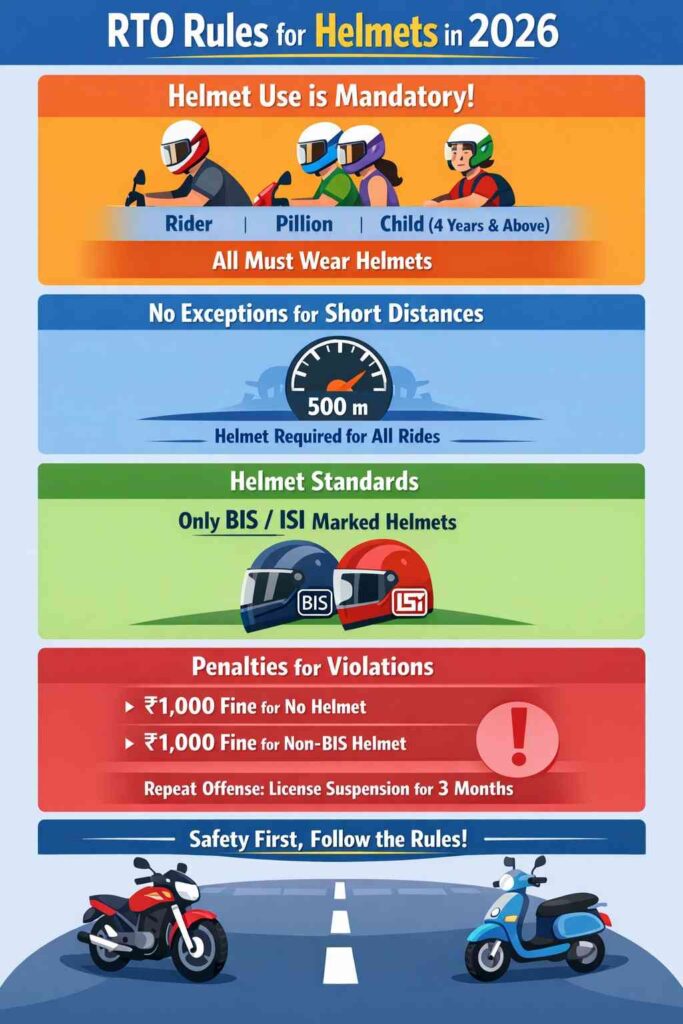
- Under Section 139 of the MVA 1988, it is mandatory for every person travelling on a two-wheeler to use a helmet, be it the driver, the pillion, or the person sitting behind the driver.
- If a child is travelling with you on a two-wheeler, then in this situation it is mandatory for him/her to wear a helmet if his/her age is at least 4 years. Helmets are not applicable for children below 4 years of age.
- Many people have a question in their mind: if one has to travel a short distance, then is wearing a helmet mandatory for that or not? Know that under no circumstances is one exempted from wearing a helmet; even if you have to travel only 500 metres, wearing a helmet is mandatory.
- There is no provision for using any specific helmet for two-wheeler driving, but it is necessary that the helmet you are using should be made as per Indian safety norms, i.e., it should be BIS-certified / ISI-marked.
Note that the Ministry of Road Transport & Highways, Government of India, has made it mandatory that with all two-wheelers sold from 1st January 2026 onwards, buyers will be given two helmets that are BIS-certified so that one is used by the driver and the other by the pillion.
What if anyone violates RTO rules for helmets in 2026?
If you are caught riding any two-wheeler, be it a motorcycle, bike, or scooter, without a helmet, then in this situation you will be fined ₹1,000. If a pillion is travelling with you and he/she is not wearing a helmet, then in this situation also a challan will be issued against your vehicle.
If you are found driving a two-wheeler using a non-BIS-certified helmet, then in this situation also you can be issued a challan of ₹1,000. In some situations, you may be let off with a warning asking you to buy a helmet that complies with Indian safety norms.
In case of violating the RTO rules related to the helmet more than once, then in this situation not only will you be issued a challan, but your driving licence can also be suspended for 3 months.