
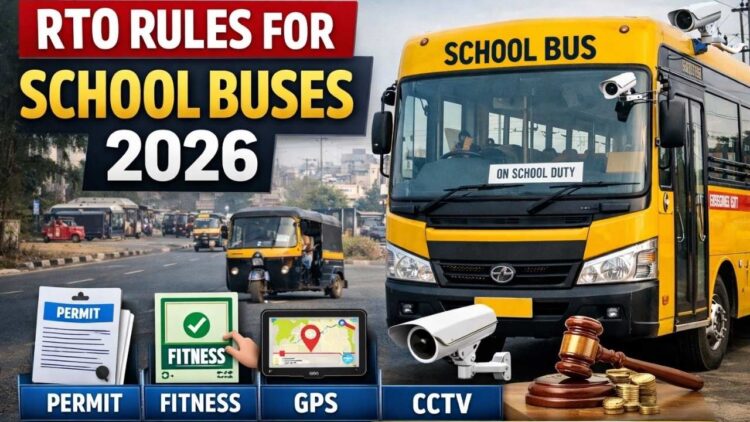
It is essential for all stakeholders involved in transporting school children to strictly follow the regional transport office rules related to school buses to ensure the safety of children, vehicle fitness, and fixing legal responsibility.
Whether you drive a school bus or a bus that transports school children, you must be aware of all relevant RTO rules. Stay tuned till then so you don’t miss any important details about it, which may cause your problems later.
RTO Rules for School Buses
The RTO rules related to school buses come under the Motor Vehicles Act and the Central Motor Vehicle Rules. They exist to ensure that children are protected, accidents do not occur, the vehicle and the driver are safe, legal responsibility is fixed, and accountability is created for the school and the operator.
What are the RTO rules for school buses?
To operate a school bus on a public road, it’s essential to strictly follow all applicable regulations. The RTO rules for the school bus are more stringent than for other vehicles, as they involve transporting minors. You can understand all the regulations related to school buses from below.
- It is necessary that the school bus be registered with the RTO and have a valid transport vehicle permit. Availability of a fitness certificate, which is renewed annually, is also mandatory. It must also be ensured that the driver has his driving license along with other documents like valid insurance, a PUC certificate, and road tax receipts.
- If the bus is owned by the school, it must have a school bus tag on both the front and back. If the bus is hired, it must have an on-school duty tag on both the front and back. The school’s name and contact number must also be displayed on the bus. There is no specific requirement regarding the color of the bus, but if it is, it should be golden yellow.
- It is mandatory for school buses to be equipped with all safety equipment, including two emergency exits, an ISI-marked fire extinguisher, a first aid kit, horizontal window grills, and a GPS tracking device.
- The school bus driver must have a valid commercial driving license and at least 5 years of driving experience, and it should also be ensured that the driver does not have a poor traffic record, and the most important thing is to ensure that a warden, conductor, or attendant is available on the bus.
- The driving speed of a school bus can be a maximum of 40 kilometers per hour, not more than that, and here also it has to be ensured that CCTV footage is installed inside the bus so that the activities of the children can be monitored and it can be ensured whether the child is reaching school from home and from school to home on time or not.
What if a school bus violates RTO rules?
If RTO rules related to the bus are violated, penalties are imposed, and various consequences may also be faced by all stakeholders, whether it’s the driver, the school, or the individual in whose name the bus is registered. The following details the penalty for each violation.
- Overspeeding can result in a penalty of ₹2,000.
- Overloading can result in a heavier penalty, depending on the number of children exceeding the seating capacity.
- If a valid permit is not available, a penalty of ₹10,000 or more can be imposed.
- If a fitness certificate is not available, a maximum penalty of ₹5,000 can be imposed.
- If insurance coverage is not available, the penalty can range from ₹2,000 to ₹4,000.
In case of no permit, expired fitness, serious safety defects, and drunken driving, the bus can be seized, and in case of repeat violation, the driving license or permit can be cancelled, and a show cause notice can also be issued to the school.