
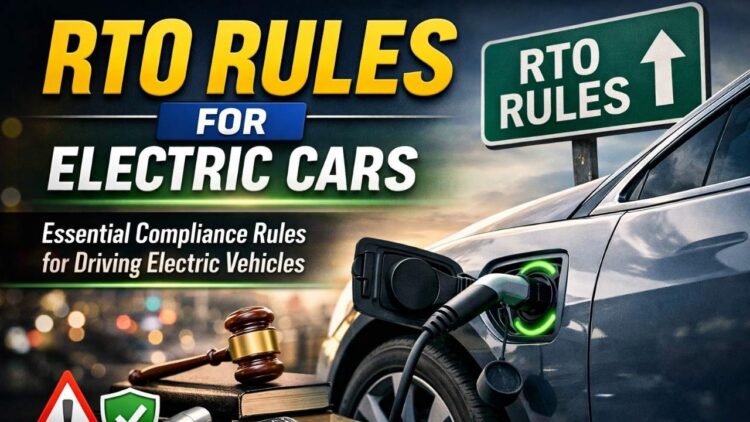
If you are thinking of buying an electric car in 2026, then it is important for you to be aware of the RTO rules related to it. Like other cars, it also has to fulfil some requirements to run on public roads, in case of violation of which you may have to face legal consequences.
In this article, we’ve discussed all the RTO rules related to electric tax in detail so you’ll understand them thoroughly. We’ve also talked about the potential problems you might face if you don’t follow the rules. Be sure to read the entire article to ensure you don’t miss any important details.
RTO Rules for Electric Cars
The RTO rules for electric cars refer to what you need to follow to drive your e-car on public roads. For your convenience, we’ve discussed all the rules separately. You can find them below.
Registration
- Like other cars, electric cars also need to be registered with the nearest RTO. After registration, you will receive an RC (Registration Certificate) by post, so be sure to keep it with you.
- If you drive it on a public road without registration, you could be fined ₹5,000, and in the case of a repeat offender, you could face a fine of ₹10,000 and a one-year imprisonment.
Number plate
- The number plate of your electric car should be green. If you want to get it for private use, in this case the colour of the text should be white, and if for commercial use, then the colour of the text should be yellow.
- If the number plate is incorrect, a fine of ₹1,000 can be imposed, and in case of misuse of the number plate, a fine of ₹3,000 and 3 months’ imprisonment can also be imposed.
Driving licence
- An MLV driving licence is required to operate an electric vehicle on public roads. If the vehicle is used for commercial purposes, you or your driver must have a commercial driving licence.
- Failure to have a driver’s licence can result in a fine of ₹3,000. Repeat offenders can increase the fine and result in up to three months in jail.
Motor Insurance
- It’s essential that you have third-party motor insurance available for your electric car, as without it, your vehicle cannot be driven on public roads.
- If motor insurance isn’t available, you’ll be fined ₹2,000, ₹4,000 for the second time, and you could face up to three months in jail for the third time.
Traffic Rules
- You’ll also need to ensure your electric car follows all traffic rules regularly, primarily speed limits, signals, and lane rules.
- Overspeeding can result in a fine of ₹1,000 to ₹2,000, and jumping a red light or driving incorrectly can result in a fine of ₹2,000 to ₹3,000.
Seat Belt
- It is essential for the driver and front-seat passengers to use seat belts.
- Failure to use a seat belt could result in a fine of ₹500 to ₹1,500.
Fitness Certificate
- Also, ensure you have a valid fitness certificate for your electric car. For private vehicles, it’s valid for 15 years after registration.
- Note that for a new commercial electric car, a fitness certificate remains valid for 2 years and that it must be renewed annually.
- If a valid fitness certificate is not available, a fine of up to ₹10,000 may be imposed and your vehicle may be impounded.
Electric cars, whether commercial or private, do not require a Pollution Under Control (PUC) certificate because their carbon emissions are zero.
After reading the article, you must have understood by now that for any electric car to run on the public road, four documents are required to be available: the first is the RC, the second is insurance, the third is the fitness certificate and the fourth is the driving licence.
If you have all these four documents, there will be no problem; just keep in mind that you follow all the traffic rules properly.