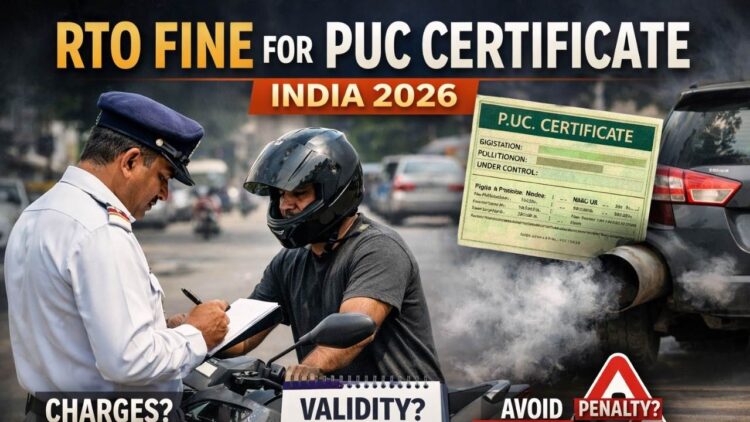
The PUC (Pollution Under Control) certificate is a vital document that is mandatory for operating any private or commercial vehicle on public roads. It applies to all roads across the country; whenever a vehicle lacks a valid PUC certificate, a fine is imposed.
The amount of the fine levied on private and commercial vehicles in the absence of a PUC certificate is similar in all states and UTs. Here, we have provided a detailed discussion regarding this subject; therefore, we strongly encourage you to read this article in its entirety.
RTO Fine For PUC Certificate
According to section 190(2) of the Motor Vehicle Act 1988, if any vehicle is found on a public road without a pollution under control certificate, whether it is private or commercial, then a fine of 1,000 rupees is imposed on it.
In case of repeat violation of the PUC Certificate, the amount of the fine is slightly different in different states and union territories; somewhere it is only 1,000 rupees, somewhere 1,500 rupees and somewhere 2,000 rupees.
Notes:
- There is also a rare scenario, a specific situation in which a fine of up to ₹10,000 may be imposed, which occurs if an individual presents a fake or tampered ‘Pollution Under Control’ certificate during a check.
- Delhi has strict regulations regarding PUC certificates; therefore, you must ensure that you do not drive without a valid PUC certificate, as doing so could result in a hefty penalty, up to ₹10,000, and you may also have to face legal consequences.
When is a fine for a PUC certificate imposed on any vehicle?
A fine related to the PUC certificate is imposed when you do not possess either a physical copy or a digital copy (via DigiLocker) of the certificate while driving, or when the certificate has expired. Most people incur a fine for their PUC certificate precisely because it has expired.
It is worth noting that, for most vehicles, a pollution under control certificate remains valid for one year, after which it is mandatory to renew it at six-month intervals, a requirement applicable to both private and commercial vehicles.
How to get a valid PUC certificate for a vehicle?
The renewal of the PUC certificate is mandatory every six months. To ensure that you always possess a valid PUC certificate, thereby avoiding any associated fines, it is essential that you renew your certificate before the six-month period expires.
To obtain a valid PUC certificate, you must visit an authorised PUC testing centre with your vehicle, where your vehicle’s exhaust emissions will be checked. If your vehicle’s carbon emissions fall within the prescribed limits, there will be no issues, and you will easily receive your PUC certificate.
What are the charges for getting a valid PUC certificate?
To get a Pollution Under Control (PUC) certificate, you have to pay a required charge to the authorised PUC testing centre, which is different for different vehicles.
The amount varies from ₹60 to ₹100 for bikes and scooters, between ₹80 and ₹120 for petrol-powered cars, between ₹100 and ₹150 for diesel-powered cars and a maximum of ₹200 for commercial vehicles.
What details are available on the PUC certificate of a vehicle?
On the pollution under control certificate of a vehicle, five crucial details are available, which are vehicle registration number, emission test results, date of testing, validity period, and PUC centre details.
To verify whether a PUC certificate is valid, it is essential that all the details mentioned on it correspond exactly with the details listed on your Registration Certificate; that is, the registration number and all other particulars must be identical on both documents.
The most critical element featured in this document is its validity period. If you show a PUC certificate during a traffic inspection after it has expired, you will undoubtedly be fined related to the PUC certificate, as expired certificates are not considered valid.