
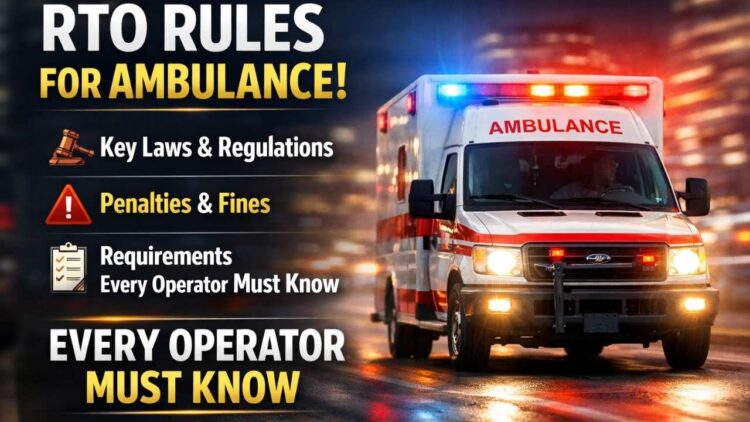
An ambulance is not just a vehicle but a mobile health care service provider. In case of emergency, where it plays a very important role in saving the life of the patient, it is necessary for the service provider and health care professional to follow the RTO rules, which are quite easy compared to other vehicles.
The RTO rules for ambulances in India come under the MVA, CMVR, and AIS-125, which are mandatory to be followed. Here, we have explained what all needs to be kept in mind for the operation of an ambulance on public roads. Read this article if you are interested in knowing the RTO rules for ambulances.
RTO Rules for Ambulance
An ambulance must comply with RTO regulations to ply on public roads, and it is the responsibility of the vehicle owner or driver to comply with all regulations under the Motor Vehicles Act of 1998. Like any other vehicle, it requires registration with the nearest RTO but is conditionally exempt from traffic regulations.
What are the RTO rules for ambulances?
The regional transport office rules for ambulances include RTO registration, commercial permits, fitness certificates, insurance, licensed drivers, AIS-125 compliance, sirens and lights, traffic priority, no misuse, and PUC certificates. Refer to the listed points to know all about it.
- It is mandatory to get the ambulance registered with the nearest original traffic office as a commercial vehicle, and it is also necessary that the RC received after registration clearly mentions the vehicle type as ambulance.
- It is necessary to have a valid commercial permit for ambulances; private ambulance service providers need contract carriage permits, and hospital-owned vehicles need institutional permits.
- It is necessary to obtain a fitness certificate for the ambulance. Keep in mind that it is new every year; renewal is given only when the engine condition, brakes, tires, lights, and medical cabin safety meet all the standards.
- It is also necessary to have insurance for the ambulance; the type of insurance should be commercial and obtained from a third party, but my recommendation is for comprehensive insurance.
- To drive an ambulance, the driver must have a commercial vehicle license, be trained in emergency driving, and have the knowledge to handle patients.
- It is mandatory to ensure compliance with the National Ambulance Code (AIS-125 Compliance). There are four types of ambulances: A is a patient transport, B is a Basic Life Support (BLS), C is an Advanced Life Support (ALS), and D is a Mobile ICU. The requirement of a fixed stretcher system, oxygen supply, medical equipment based on the type of ambulance, and proper interior space and hygiene is mandatory.
- The ambulance must have flashing beacon lights (blue/white), a siren system, and reflective ‘AMBULANCE’ markings. The siren and lights may only be used in case of emergency.
- Ambulances are given conditional exemptions from following traffic rules. They can also overspeed and cross traffic signals in case of emergency, but keep in mind that public safety should not be affected.
- The ambulance cannot be used for personal transport or non-medical commercial use under any circumstances.
- An ambulance must have a pollution control certificate, even if it is for emergency services.
- The ambulance must have a commercial number plate, and clear Ambulance signage should also be available on it.
What if an ambulance is found not following the RTO rules?
An ambulance is an emergency vehicle that plays a crucial role in saving the lives of people. If it does not follow the RTO rules, then in this situation strict action can be taken against the owner/driver. We have discussed this below.
- In case of not having a registration permit, valid fitness certificate, or insurance, a penalty of ₹5,000 to ₹10,000 can be imposed.
- If the ambulance is unregistered, does not meet the fitness requirements, or a permit is not available, then in this situation it can be seized.
- If an ambulance violates any RTO rules more than once, then in such a situation the permit can be cancelled and/or the operation license can be suspended.
- If the driver does not have a commercial license to drive an ambulance or if he/she drives dangerously or misuses the siren, then in this situation his/her license will be cancelled immediately, and he/she may also face a court case.
- If the ambulance is found in service without equipment or without approval, the operator can be completely blacklisted and the permit can be permanently cancelled.
- If PUC is not available for an ambulance, then a fine of up to ₹10,000 can be imposed on it.
The penalty is not only for the driver or owner of the ambulance but also for the owner or driver of any other vehicle running on the road if they do not give clearance to the ambulance. In case of blocking the way of an ambulance, the person doing so may have to pay a penalty of up to ₹10,000.