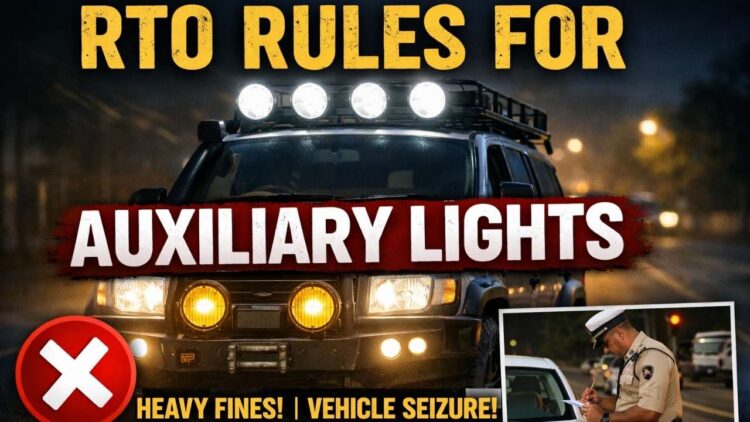
Auxiliary lights are mounted in front, which include fog lamps, driving lamps or spotlights, and LED bars or aftermarket light bars. In India, the RTO rules related to auxiliary lights for all types of vehicles come under the Motor Vehicles Act, 1988, and Central Motor Vehicles Rules.
Here, we’ve discussed the regional transport office rules for auxiliary lights in detail. By reading this article thoroughly, you can learn about the RTO rules for auxiliary lights in India and what action is taken if someone doesn’t follow these rules, and much more.
RTO Rules for Auxiliary Lights
Many people in India install auxiliary lights in their car, bike, scooter, and other vehicles with the aim of enhancing the look of their vehicle, but be aware that doing so is often considered a violation of the RTO rules, which can lead to penalties and other problems too.
Before installing auxiliary lights on any vehicles, it is important for the owners to be aware of the RTO rules related to it. It is not that installing auxiliary lights is completely prohibited; it can be done if required but by following certain rules and regulations.
What are the RTO rules for auxiliary lights?
If you are thinking of adding auxiliary or additional lights to your car, bike, or any other vehicle, then you must read the following points and understand the related RTO rules so that you do not face any problems later.
- Any additional light can be installed in a vehicle only if it meets the approved safety & technical standards under the Motor Vehicles Act and CMVR. Please note that use of uncertified aftermarket LED or HID kits is prohibited, and doing so is considered an illegal modification.
- The auxiliary or fog light that you can install in your vehicle should not be above the main headlights; it has to be installed below them.
- A maximum of four lights can be used in the front of any vehicle, including headlights. Auxiliary lights that you want to install in your vehicle must not exceed the maximum cap.
- The auxiliary or fog lights you’re considering installing on the front of your vehicle should be white or amber/yellow. Red, Blue, and Green Life are strictly off-limits and are only available for service vehicles and within the regulations.
- Auxiliary lights can only be used in poor visibility conditions, such as when there is dense fog, heavy rain, or heavy dust; another rule regarding this is that high beams should not be used when auxiliary lights are being used, as this may dazzle other drivers.
- It is essential to keep the alignment of the additional or auxiliary light in the vehicle proper because due to this, the oncoming vehicles may have to face blindness or dazzle, which can lead to the risk of accident.
- Making changes to the installed lighting or adding auxiliary lights after the vehicle’s registration is considered illegal unless it has been certified or approved by the RTO. Please ensure that any auxiliary lights you use on your vehicle are ARAI/CMVR certified.
- Flashing, strobe, and beacon-type light patterns in unauthorized colors are strictly prohibited. They cannot be used in any private or commercial vehicle; they can only be used in service vehicles, only if permitted to do so.
What if anyone violates RTO rules for auxiliary lights?
Violating RTO rules related to auxiliary lights can attract a fine of up to ₹5000 under Section 190(2) of the Motor Vehicles Act for unauthorized LED bars, spotlights, or altering factory lighting, in which case the illegal modification is removed on the spot.
If this is a repeated violation, your vehicle can also be seized. If you drive your vehicle with auxiliary lights installed without RTO permission, it will be considered an illegal modification, due to which your vehicle’s fitness certificate will also be considered invalid, and it will also be difficult to claim insurance.
In case of serious or repeated violations, there may be registration-related issues. Authorities will only allow the vehicle to be used if all rules are strictly followed. And if your auxiliary lighting illegal use causes problems for other drivers and creates a risk of an accident, you may also face a court case.