
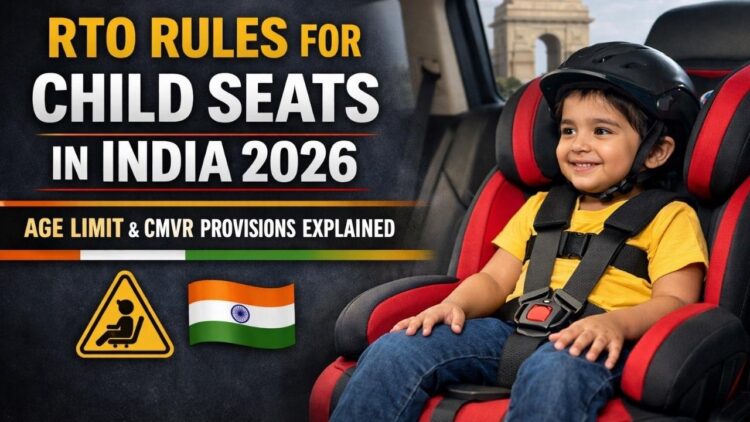
In India, parents are required to follow RTO regulations regarding child seats, as they play a vital role in saving children’s lives in the event of an accident. According to the WHO, child safety harnesses reduce concussion injuries by 70% in infants and 54% to 80% in young children.
Currently, many car owners in India do not prioritize the safety of their children, ignoring the fact that they even need a child seat. It is not that all parents deliberately do not follow these things; one of the reasons behind this is lack of awareness among them about it.
But now people are slowly becoming aware of this and realizing how important it is to have a child seat in their car, as it plays a crucial role in saving the lives of their loved ones in the event of an accident. Stay tuned not to miss any RTO rules for the child seat, which could cause problems later on.
RTO Rules for Child Seats
Under the Motor Vehicles (Amendment) Act, 2019, and Central Motor Vehicles Rules provisions, it is mandatory to ensure that the child is properly secured while travelling by car. Section 194B of the Motor Vehicles Act mandates that children aged 14 years and below must be provided with a safety belt or an approved child restraint system.
It is very important to follow the RTO rules related to child seats because if you do not follow them, then you may get a penalty, and importantly, ignoring them may result in something bad happening to your dearest one. So make sure that you follow all the rules properly so you don’t get fined, and even if your vehicle meets with an accident, your child remains safe.
Under the CMVR, it has now become mandatory that all cars manufactured after April 1, 2015, should have provision for installing child restraint systems in at least one seat. These rules have been introduced so that parents can ensure the safety of their children while travelling, and in case of any untoward incident like an accident, the children should suffer minimum injuries.
What are the RTO rules for child seats?
The RTO rules for the child seats are crucial; it is mandatory for all the parents to follow these rules to drive with a child to ensure his/her safety. Refer to the listed points to check the regional transport office rules for child seats.
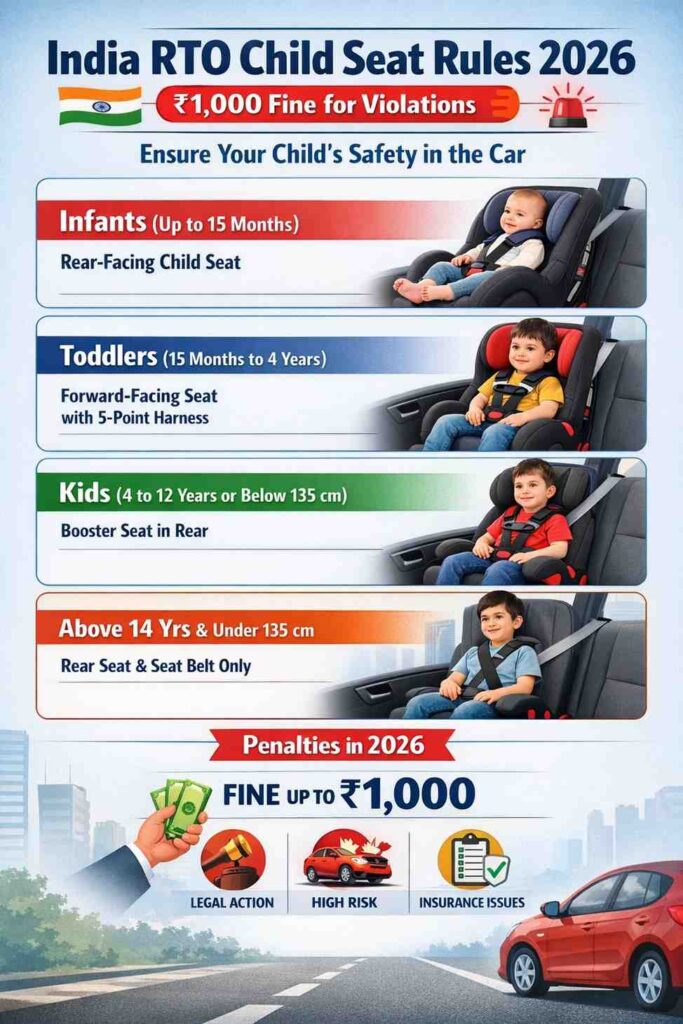
- For infants up to the age of 15 months, you need a rear-facing child restraint system (CRS) because it provides support for the neck and spine.
- For children over 15 months and under 4 years, you need a forward-facing CSR, ensuring it has a 5-point harness.
- For children between the ages of 4 and 12 years or who are less than 135 cm tall, you need a booster seat (toddler) that fits their shoulders and hips properly.
- If a child is above 14 years of age but his height is less than 135 cm, then in this situation it is not appropriate for him/her to sit in the front seat. He/She should be made to sit in the rear seat and use a booster seat and be mounted properly with the seat belt.
After installing a child seat in a car, make sure that its movement does not exceed 2.5 cm, the seat being used is neither expired nor damaged, and the harness stripes are neither too loose nor twisted.
Who violates RTO rules for child seats?
In 2026, if you violate RTO rules related to child seats, you could be fined up to 1,000 rupees and face other consequences too. And if you have an infant traveling with you and there’s no child restraint system, the penalty could be substantial.