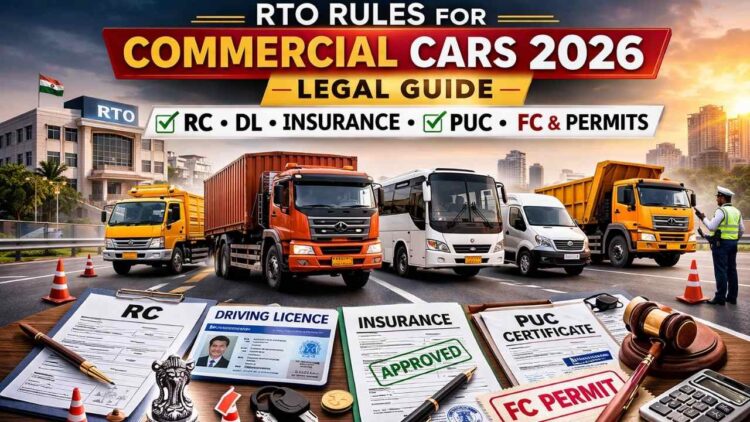
The current RTO regulations in India regarding commercial vehicles fall under the Motor Vehicles Act, 1988. These regulations have been formulated to ensure that every car operating on public roads for commercial purposes adheres strictly to the established rules, thereby also guaranteeing road safety.
Just like other commercial vehicles, commercial cars are also subject to specific RTO rules that must be strictly adhered to; failure to do so not only results in penalties but may also lead to facing significant consequences. Stay tuned so you don’t miss any important details about the RTO rules for commercial cars.
RTO Rules for Commercial Cars
In India, for any car to be used commercially on public roads, it is mandatory that it comply with all of the following Regional Transport Office rules and regulations introduced by the Ministry of Road Transport and Highways, Government of India.
Registration
- It is mandatory that your car be registered as a transport vehicle with your nearest RTO in order to use it for taxi, rental, or delivery services.
- Please note that for commercial vehicles, it is mandatory for the number plate to be yellow with black lettering.
- If your vehicle is not registered as a transport vehicle, and you are found using it commercially, you will be liable for a fine of ₹5,000.
Permit
- If you wish to move your commercial vehicle from one location to another within the specific state where it is registered, you must possess a State Permit.
- However, if your vehicle is to be used commercially across all corners of the country, then, in that scenario, you must hold a National Permit.
- To obtain a permit, you do not need to go anywhere else; you will receive it from the very same RTO where you registered your car as a transport vehicle.
- If your commercial vehicle is found operating on a public road without a permit, you may face a fine of up to ₹10,000, and your vehicle could also be impounded.
Fitness Certificate
- For commercial cars, it is mandatory to possess a valid fitness certificate.
- It is worth noting that after the purchase of a new vehicle, the fitness certificate remains valid for two years, after which it must be renewed every two years.
- Once the vehicle reaches an age of eight years, the renewal of the fitness certificate becomes an annual requirement.
- A fitness certificate is mandatory. If you do not possess one, you could face a fine ranging from ₹2,000 to ₹5,000, and your vehicle will be impounded until a valid fitness certificate is obtained.
Insurance
- Third-party insurance is mandatory for commercial vehicles as well.
- It is important to note that this insurance must also be commercial in nature, i.e., should cover aspects such as passenger liability and third-party liability.
- It is mandatory to have third-party commercial insurance for a commercial vehicle. Failure to possess this can result in a fine exceeding ₹2,000, as well as imprisonment for up to three months.
Driving Licence
- To operate a commercial vehicle on public roads, it is mandatory for the driver to possess a commercial driving licence.
- It is important to note that driving a commercial vehicle with a private driving licence is prohibited; you may face consequences.
- If you are caught driving a commercial vehicle without a valid driving licence, or while using a licence issued for a private car, you will be subject to a fine of ₹5,000.
PUC Certificate
- To operate any commercial vehicle, unless it is an electric vehicle, it is mandatory to possess a Pollution Under Control certificate.
- Please note that following the purchase of a new vehicle, the pollution certificate remains valid for one year; thereafter, it is mandatory to have it renewed every six months.
- It is illegal for any commercial vehicle to operate on public roads without a PUC certificate. If a vehicle is found to be operating without a valid PUC during a check, a fine of ₹10,000 may be imposed, and the driver could also face imprisonment for six months.
Notes:
- In the country’s major cities, only those vehicles may be used for commercial purposes that are BS6-compliant, CNG-powered, or electric.
- For vehicles operating on public roads for commercial purposes, it is mandatory to strictly adhere to speed limits and to completely avoid using areas that are commercially restricted.
- RTOs in many regions have issued directives requiring all commercial vehicle operators to install panic buttons and GPS tracking devices in their vehicles to ensure public safety. You will need to verify with your local RTO whether or not this requirement is mandatory in your specific state.
- A ‘Green Tax’ is levied on all commercial vehicles that are more than 8 years old (if diesel-powered) or more than 10 years old (if petrol-powered) whenever they enter another state; the amount of this tax typically ranges from ₹2,000 to ₹3,000.
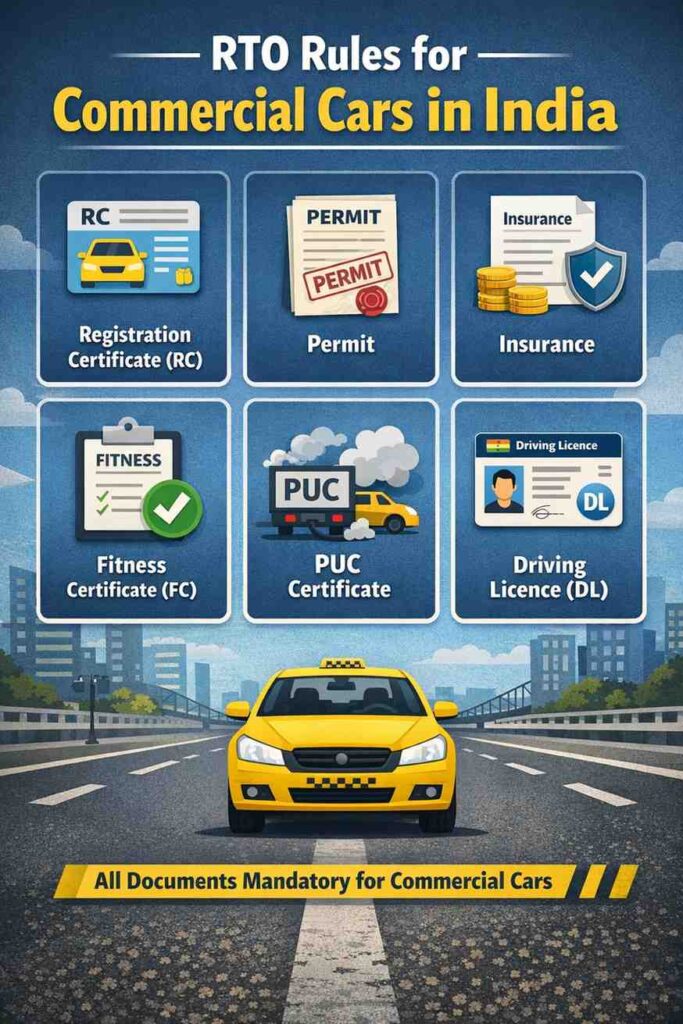
If one takes an overall view of the RTO rules applicable to commercial vehicles, the conclusion is that driving such a vehicle requires six essential documents, which are the RC, Permit Copy, Insurance, FC, PUC Certificate, and DL; furthermore, that strict compliance with all safety regulations is ensured.