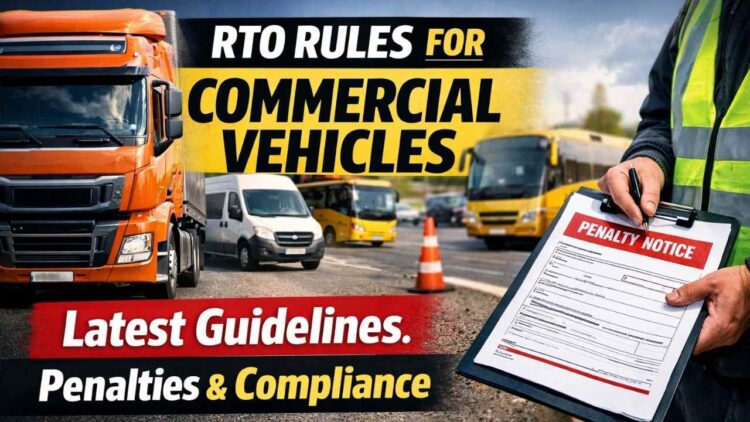
The Ministry of Road Transport and Highways, Government of India, has made many changes in the RTO rules for commercial vehicles, which is very important for trucks, taxis, buses, and goods carriers to know, because even complaints against these can lead to penalties.
The MoRTH, GOI, has updated RTO rules for commercial vehicles to ensure that the environment is as little polluted as possible, road safety is increased, and clean transportation is promoted. By reading this article, you will know the RTO rules for commercial vehicles.
RTO Rules for Commercial Vehicles
The RTO rules for commercial vehicles in India are based on the National Clean Air Programme and Vehicle Scrappage Policy 2021, as the MoRTH and GOI want to ensure that the vehicles running on the road for commercial use have zero or minimum carbon emissions so that there is not much impact on the environment.
The new regional transport office rules for commercial vehicles are primarily aimed at promoting vehicles that are either electric or run on CNG/LNG. The sole motive behind the rules is not only to reduce air pollution but also to save fuel and promote green transportation in the country.
What are the RTO rules for commercial vehicles in 2026?
In 2026, it is mandatory for a commercial vehicle to follow all the rules to ply on public roads, which are as follows.
- Availability of all required documents is mandatory, which includes a valid registration certificate, valid permit, insurance, fitness certificate, pollution certificate, and driving license.
- It is mandatory to have a valid fitness certificate. For a new commercial vehicle, the certificate is initially valid for 2 years, and thereafter it has to be renewed every 2 years, and if the vehicle is 8 years old, then in that case renewal is mandatory every year.
- If a commercial vehicle is 15 years old, then it comes under the Vehicle Scrappage Policy 2021, under which the vehicle is scrapped if it does not pass the annual fitness test.
- If the commercial vehicle operates only in one state, then a state permit is required; if it has to operate in the entire country, then a national permit is required. As per the latest rules, if the toll is not paid, then the national permit and fitness certificate will not be renewed.
- Overloading is completely illegal for commercial vehicles. If the weight of the vehicle is found to be more than the GVW, i.e., gross vehicle weight, then in this situation not only will a heavy fine be imposed, but the permit will also be cancelled, and in some cases the vehicle itself will be seized.
- Now it has become mandatory for even new vehicles to have Advanced Driver Assistance Systems (ADAS). The Acoustic Vehicle Alerting System (AVAS) is going to be mandatory for all commercial vehicles from October 2026. Apart from this, there may also be a need to install tracking devices in some commercial vehicles.
- For commercial vehicles, if the challan remains unpaid, insurance renewal may be stopped, and the vehicle may also be blocked from RTO services.
Apart from these RTO rules, it is also necessary that you also follow the state-related rules, as after 31 October 2026, BS-4 commercial vehicles will not be allowed to enter Delhi, although vehicles registered with the RTO in Delhi are exempted from it.
What if a commercial vehicle violates RTO rules?
If any commercial vehicle, like a truck, bus, taxi, tempo, pickup, etc., is caught violating RTO rules, then in this situation it is penalized, and in some cases it may have to face vehicle seizure, permit cancellation or suspension, and driving license suspension.
First, let us know about the penalties and how many penalties can be imposed on you in which situations.
Document-Related Violations
- Driving without a valid RC: ₹5,000
- No Permit (Goods/Passenger Vehicle): ₹10,000
- No Fitness Certificate: ₹2,000 to ₹10,000
- No Insurance: ₹2,000 (first), ₹4,000 (repeat)
- No PUC Certificate: ₹1,000
- No Driving License (Transport Category): ₹5,000
- Expired documents: ₹2,000 to ₹5,000
Overloading & Goods Violations
- Overloading truck: ₹20,000 + ₹2,000 per extra ton
- Unsafe loading (falling goods): ₹5,000
- Carrying prohibited goods: Case + heavy fine
Passenger Vehicle Violations
- Carrying extra passengers: ₹1,000 per extra passenger
- Operating without a route permit: ₹10,000
- Illegal passenger transport in goods vehicle: ₹10,000
Driving-Related Offences
- Over-speeding (commercial vehicle): ₹2,000 to ₹4,000
- Dangerous driving: ₹5,000
- Drunk driving: ₹10,000 + possible jail
- Using a mobile while driving: ₹5,000
- Jumping a red light: ₹5,000
Vehicle Condition Violations
- Driving without Fitness: ₹5,000 to ₹10,000
- Faulty brakes/tires: ₹5,000
- No reflector/tail light (goods vehicles): ₹500 to ₹1,500
Tax & Permit Issues
- Road tax unpaid: Fine + tax recovery
- Permit condition Violation: ₹5,000 to ₹10,000
- Operating outside permit area: ₹5,000
In case of not having a valid permit, serious overloading, an expired fitness certificate, illegal passenger transport, and repeated violations, your vehicle may be seized; if any RTO rule is violated repeatedly, the situation you promise may be suspended or cancelled; and drunk driving, dangerous driving, and hit-and-run cases may result in driving license suspension.