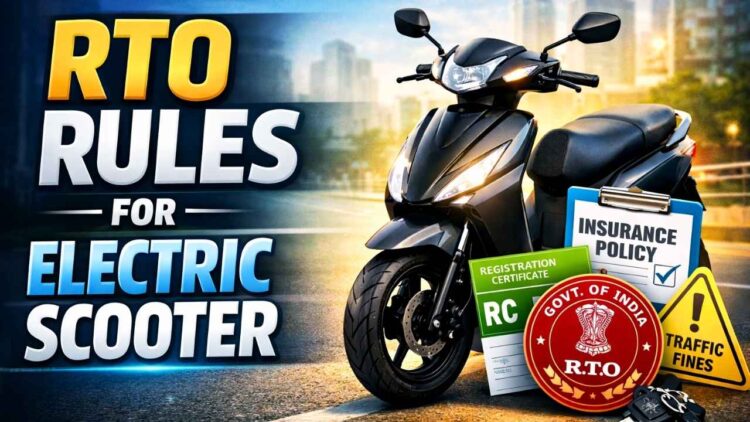
If you’ve recently purchased an electric scooter or are planning to purchase one, it’s important to be aware of the RTO rules for e-scooters. The RTO rules for e-scooters are specified under the Motor Vehicles Act of 1998 and its 2019 amendments.
Here, we have discussed in detail the RTO rules for e-scooters in India. By reading this article you will get to know which rules you need to follow to drive an electric scooter on public roads. We have also shared what consequences one has to face if the rules are not followed.
RTO Rules for Electric Scooters in India
The electric scooters available in the Indian market have been defined in two categories: the first is the low-speed electric scooter, and the second is the high-speed electric scooter. The RTO rules for both types of e-scooters are slightly different; basically, low-speed electric scooters are exempted from some RTO rules.
Low-speed e-scooters are those two-wheeled EVs whose top speed is a maximum of 25 km/h; the motor installed in them does not generate more than 250W of power. However, all the e-scooters whose maximum speed is above 25 km/h and the motor power in them is above 250W are called high-speed e-scooters.
According to Indian RTO rules, low-speed electric scooters require neither registration nor a license, but all traffic rules apply, and breaking them can result in a penalty. All high-speed electric scooters are subject to the same RTO rules as petrol-powered two-wheelers.
What are the RTO rules for the low-speed and high-speed electric scooters?
We have shared the RTO rules for low-speed and high-speed e-scooters under the Motor Vehicle Act in the table given below. You can look at the table and know which regional transport office rules you need to follow if you have a low-speed or high-speed electric scooter.
| Rule | Low-Speed Electric Scooter | High-Speed Electric Scooter |
| Driving Licence | Not required | Required |
| RTO Registration | Not required | Mandatory |
| Number Plate | Not required | Required |
| Insurance | Not compulsory (Recommended) | Mandatory |
| Helmet | Mandatory | Compulsory |
| Minimum Age to Ride | 16 years | 18 years |
| RC (Registration Certificate) | Not issued | Issued by RTO |
| PUC Certificate | Not required | Not required (EVs have no emissions) |
| Road Tax | Usually exempt | May apply (often subsidized in many states) |
| Traffic Rules | Must follow traffic rules | Must follow traffic rules |
| Where You Can Ride | Local roads, city use | All roads, highways (as per rules) |
| Modification Allowed | Not allowed to increase speed | Illegal without approval |
By now you must have understood from the above table that if you have a low-speed e-scooter or are planning to buy it, then you will be able to drive it on public roads without any driving license or RTO registration if you are at least 16 years old, and it is mandatory to follow all the TRO rules for high-speed electric scooters; otherwise, penalties will be imposed.
What are the penalties for not following the RTO rules for electric scooters?
If the RTO rules are not followed, then in this situation the vehicle owner may have to pay a fine and face legal consequences, like how low-speed e-scooters are exempted from registration and license, but violation of traffic rules will attract a penalty, and in the case of high-speed e-scooters, breaking any rule will attract a penalty.
Under the Regional Transport Office (RTO) rules, the penalty amount varies for the violation of different rules from state to state. You can check the table given below to know how much you will be fined if you are caught not following any RTO rule for your electric scooter.
| Violation | Penalty |
| Riding without driving licence | ₹5,000 |
| Riding without registration (RC) | ₹5,000 |
| No insurance | ₹2,000 (₹4,000 for repeat offence) |
| No helmet | ₹1,000 + possible licence suspension |
| Underage driving (below 18 on high-speed EV) | ₹25,000 + vehicle owner liable, possibility of jail |
| No number plate | ₹5,000 |
| Dangerous / rash driving | ₹1,000 to ₹5,000 |
| Modifying low-speed scooter to make it faster | ₹5,000 + vehicle seizure possible |
| Triple riding | ₹1,000 |
| Jumping traffic signal | ₹1,000 to ₹5,000 |
Note that if someone clarifies that his or her electric scooter is low-speed and if its motor power is more than 250W, then in this case it will be considered a high-speed e-scooter, which means that it will be subject to all the penalties that are applicable to a regular e-scooter.
Notes:
- There is no need for a PUC certificate for e-scooters because the carbon emission of e-scooters is zero.
- The necessary documents that you need to keep with you while driving the scooter are your RC smart card, driving insurance, identity card, and purchase invoice, if it is not more than 30 days old since the purchase.
- If your electric scooter falls under the high-speed category, then the number plate you must have should have a green background and the text in white color if it is a private vehicle, and if it is a commercial vehicle, then the background should be green, but the text color must be yellow.
Is the RTO registration required for an e-scooter?
If the e-scooter you own or are planning to buy has a top speed above 25 km/h, then RTO registration is absolutely mandatory. For the same, you will have to go to the nearest RTO with all the required documents, and along with the registration fee, you will also have to pay the road tax, if applicable in your state.
If you buy a new high-speed electric scooter, you will get a temporary registration certificate (RC), which is generally valid for 30 days. Within 30 days, you will have to register with the RTO and get your permanent RC smartcard; only then will you be able to drive it on the public road.
And if the electric scooter purchased is second-hand, then in this situation it is mandatory to change the name in the RC within 14 days. If the scooter you have purchased is from some other state, then in this situation you will have a full 45 days to update your name in the RC. Failure to do so may result in penalties.