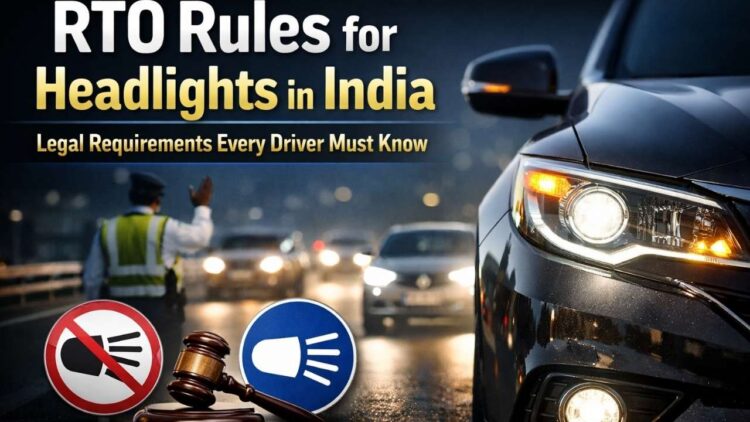
There are RTO rules for headlights for all private and commercial vehicles in India, which come under section 106 of the Motor Vehicles Act. It is important to follow these rules because due to their violation, many accidents have been seen, which have resulted in loss of life.
Many people deliberately modify the lighting in their vehicles to make their vehicles look cool, but due to this, they face problems for themselves and other vehicles running on the road. Due to which situations like accidents occur, to reduce these things, the RTO rules for headlights play an important role.
Vehicle owners often take lighting as a mere accessory, but the truth is that it plays a very important role in road safety, as a vehicle whose lighting is not as per the regulations can have a lot of problems driving during low visibility. Here, we discussed all you need to know about the RTO rules for headlights in India.
RTO Rules for Headlights in India
It is mandatory for various private and commercial vehicles plying on the roads in India to follow the RTO rules for the headlights of their vehicles, which come under section 106 of the Motor Vehicles Act. These rules are as follows.
- All vehicles are required to have two types of headlights, which include high beams and luminaires.
- The bulbs fitted in them should not be too powerful, as it may cause problems for the driver or other drivers.
- The maximum wattage of headlights for vehicles is 70 watts; exceeding this would be a violation of the rules.
- A vehicle can have a maximum of four lights, which include both fog and auxiliary lights.
- The use of blue light in the vehicle is completely prohibited, but it can be used in emergency situations.
- The driver has to ensure that the high beam is switched off whenever a vehicle is approaching to avoid any risk of an accident.
- Any kind of modification to the headlights of any vehicle is completely illegal, whether the modification is to change the design or to increase the power.
What if someone violates the RTO rules for headlights?
It is definitely necessary to follow the RTO rules for vehicle headlights. In case of any kind of violation, a penalty is imposed. If the rule is broken for the first time, then in this situation the penalty is only ₹500, but if the violation is repeated, then in this situation a penalty of ₹1,500 is imposed.
Violating RTO rules for vehicle headlights not only results in a penalty, but also the concerned authorities can remove the excessive or illegal lighting. If a new vehicle fails to comply with RTO rules regarding headlights, its RTO registration is not approved until the things are fixed.
Some states may have rules regarding headlights, and if a vehicle’s taillight or indicator is defective or broken, a penalty of up to ₹2,000 can be imposed in such a situation. If you do not want to get penalized, make sure you follow all the RTO rules for headlights.
Why is a vehicle’s headlight modification not allowed in India?
Modification of headlights of vehicles is strictly prohibited in India, as their modification leads to many problems, details of which are listed below.
- It often increases the power of headlights, causing others to misjudge the speed or distance of an oncoming vehicle.
- It can also obscure hazardous potholes or debris from the driver’s view, increasing the risk of accidents.
In the last few years, many accidents have occurred due to red-blue strobe lights and siren-like hooters, due to which many people have lost their lives. To rectify this, in 2025, the Supreme Court ordered the traffic authorities to strictly follow section 198a of the Motor Vehicle Act.
For not following the infrastructural and design rules, a fine of up to ₹1 lakh can be imposed on the designated authority, contractor, or consultant. Note that the penalty is certain if any of the following rules are violated:
- You should not use high beam headlights in urban areas and around other vehicles unless necessary.
- Never drive with non-functional headlights, tail lights, or brake lights.
- Keep in mind that no color or flashing light should be used in your vehicle.
- Do not install extra LED lights in your vehicle, even by mistake, nor use a high-intensity beam.