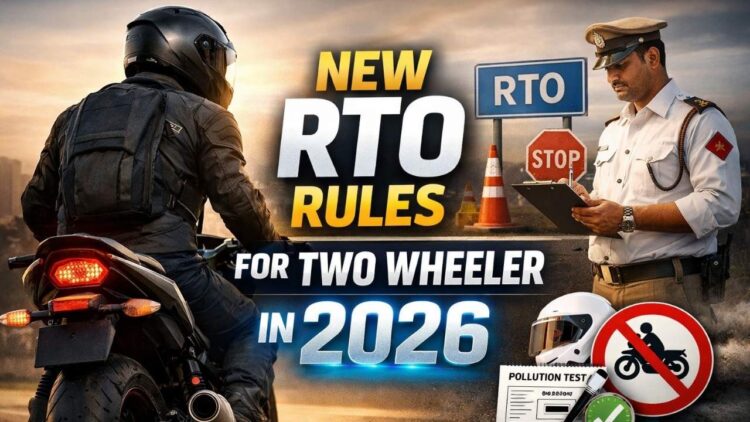
Whether you own a two-wheeler like a bike or scooter or are planning to buy a new one, you must know the RTO rules related to it. Because to drive it on public roads, you need to follow certain things. If you do not follow them, penalties are levied, and in some situations, you may have to face other problems also.
In India, the RTO rules for two-wheelers have been made to ensure that not only the driver and pillion of the bike or scooter but also anyone on the road is safe, and all traffic rules are followed properly. Stay tuned to know what the RTO rules are for two-wheelers in 2026 and what happens if you violate them.
RTO Rules for Two Wheelers in 2026
In 2026, the enforcement of RTO regulations related to two-wheelers has been further strengthened to ensure that all two-wheelers plying on public roads follow the rules and regulations. It is mandatory that you drive your bike or scooter on public roads within the rules; otherwise, you will not only be fined but may also have to face other cases.
In the last few months, there has been a slight increase in the sales of e-bikes and e-scooters in India, so it is important to know the RTO rules for them as well if you have an electric two-wheeler or are planning to buy one. RTO rules are slightly different for petrol and electric two-wheelers, which you will understand after reading this article completely.
What are the 2026 RTO rules for two-wheelers?
We have discussed below the RTO rules for electric and petrol two-wheelers, i.e., bikes or scooters. By reading the following points, you can understand what rules you have to keep in mind while driving your bike or scooter on public roads.
- All petrol two-wheelers and electric two-wheelers having power more than 250W and a top speed more than 25 kmph are required to get their registration certificate and number plate registered with the nearest RTO.
- All those two-wheelers that require registration from the nearest RTO, it is necessary to have a valid driving license to drive them on public roads.
- For all petrol-powered and electric two-wheelers above 250W power, it is mandatory to have a registration certificate, third-party insurance, and a valid driving license to drive on public roads. For petrol-powered bikes and scooters, it is also necessary to have a Pollution Under Control (PUC) certificate, but not for electric-powered two-wheelers because their carbon emission is zero.
- Be it a petrol-powered or electric-powered two-wheeler, it is mandatory that you wear an ISI-marked helmet while driving, and if you have a pillion with you, he/she is also required to wear a helmet. Keep in mind that not more than two people are sitting on a two-wheeler; it is considered a violation of the rules, even if everyone is wearing a helmet.
- While driving a two-wheeler, it is also necessary that you drive within the speed limit; illegal modifications like loud exhaust, fancy number plates, and altered silencers are completely banned. Engine modification can be done, but only after approval from the RTO.
- Driving under the influence of alcohol is strictly prohibited even if the person is choosing to follow all other rules, and using a mobile phone while typing is prohibited. It is very important to keep these two things in mind.
- It has now become mandatory for all two-wheelers to get HSRPP, i.e., a high-security number plate, installed on their bike/scooter, whether it is newly purchased or old. HSRP is available in new purchases, but old ones need to be replaced by themselves, for which they have to visit the nearest RTO.
If seen overall, to drive any two-wheeler on a public road, one has to follow all the traffic rules; apart from that, one has to keep four important documents with oneself. It is better to keep the physical copy of the same with one; if carrying the physical copy is risky for you, then save it in the Digilocker. Those four documents are:
- Driving License
- Registration Certificate
- Insurance, and
- PUC Certificate, not applicable for e-bikes and e-scooters.
If you are going to buy a new two-wheeler, then you must know about a new rule. From 1st January 2026 and onwards, it has become mandatory for all two-wheelers purchased to have an Anti-Lock Braking System (ABS), so keep this thing in mind while buying a new bike or scooter.
What if anyone violates any RTO rules for two-wheelers?
If you violate any of the RTO rules for two-wheelers, you will have to pay a penalty; in some cases, you may have to face consequences like license suspension and imprisonment. Check the penalty imposed for violating various RTO rules from the table given below.
| Violation | Fine |
| Riding without driving licence | ₹5,000 |
| Riding without registration (RC) | ₹5,000 |
| No third-party insurance | ₹2,000 (1st time) / ₹4,000 (repeat) |
| No helmet (rider or pillion) | ₹1,000 |
| Triple riding | ₹1,000 |
| Overspeeding | ₹1,000 – ₹2,000 |
| Drunk driving | ₹10,000 |
| Dangerous riding / stunt riding | ₹5,000 |
| Using mobile while riding | ₹5,000 |
| No Pollution Certificate (PUC) | ₹10,000 |
If you are caught driving without a license or RC, your vehicle can be seized. In case of non-availability of insurance or a helmet, not only will you be fined, but you can also be imprisoned for up to three months. In case of drunken driving and rash driving, the maximum jail term is 6 months.