
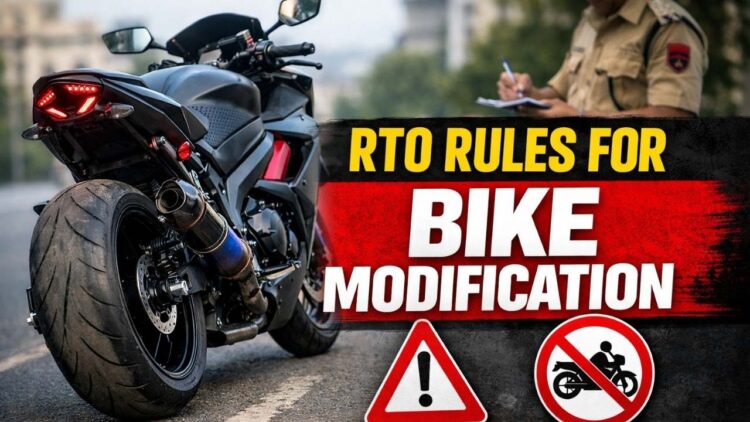
Riders like to make modifications to enhance the looks and power of their bikes. If you are also thinking of getting your bike modified, then first of all you should know that doing so is completely prohibited under section 52 of the motor vehicle act of 1988 unless the RTO approval is obtained.
In 2026, RTO rules regarding bike modification in India are a bit strict, violating which can result in heavy penalties and, in some cases, even lead to the bike being impounded. Stay tuned to learn what the RTO rules are for bike modification and what happens if anyone violates these rules and regulations.
RTO Rules for Bike Modification
Any structural, powertrain, electrical, or cosmetic changes to a bike that alter the engine, chassis, dimensions, weight, and fuel system are called modifications. If you are considering structural, powertrain, electrical, or cosmetic changes to your bike, it is important to know the RTO rules first, as doing anything without them can create problems for you.
It is not that bike modification is not allowed; it is allowed, but under the RTO rules, if you modify your bike by ignoring those rules, then even if that modification is allowed, you will have to face the consequences. This is because the job of the RTO is to ensure that everything plying on the public road runs within the rules.
What are the RTO rules for bike modification in 2026?
In 2026, the RTO rules for bike modification come under the Motor Vehicle Act of 1988 and the Central Motor Vehicles Rules of 1989; they are as follows:
- Any modification to the bike is not allowed without RTO approval, which changes the original specification of the bike as available on the RC, i.e., registration certificate. These include four main things, which are five dimensions (length, width, and height), fuel type, engine capacity, and chassis/frame.
- Changing the color of the bike is completely allowed. You can apply any type of color or wrap on your bike, but it is necessary to inform the RTO about it because during RC check your bike can be considered illegal if the color mentioned on it and the present color do not match.
- Most riders get exhaust modification done on their bikes, but it is illegal if the exhaust sound exceeds prescribed decibel limits, it violates pollution norms, or it is not ARAI-approved; only stock or government-approved exhaust systems are allowed, nothing else.
- Engine modification of the bike is a very crucial thing. RTO does not allow it for private bikes; this is because it changes the power output, affects the emission certificate, and also alters the safety compliance. If you are considering engine modification, then first try to get the approval of the RTO, and if you get it, then proceed further.
- Structural and chassis modifications are also strictly prohibited; you cannot cut or weld the frame, change the wheelbase (i.e., the distance between the first and second wheels), or convert a normal bike into a chopper-style type bike, and the setting structure cannot be significantly altered. These modifications are prohibited because they have a huge impact on safety and stability.
- You cannot make any modifications to your bike related to lighting. Installing flashing red/blue lights, strobe lights, high-intensity illegal LEDs, and underglow neon lights is strictly prohibited; only those that fall within the limits can be used.
- There is no problem in getting the wheel modified to the size recommended by the manufacturer, and no RTO approval is required for this. In the case of oversized tires and wider rims, it will be considered an illegal modification.
- If modifications are approved by the RTO, safety equipment such as rearview mirrors, horns, indicators, and reflectors must be ensured; the bike’s fuel type can also be changed, but only using a government-approved kit, and that too after obtaining RTO approval.
If you want to change any of these things, then you will have to get approval from the RTO. After getting the approval, you can get the modification done, and then you have to visit the RTO with your bike for physical inspection, after which the details of the modification will be updated in your RC.
After getting the modification done, once the details in the registration certificate (RC) are updated, you must inform your insurance company that they will make changes in your premium, and if they are not aware of this, then in this situation your claim may be rejected.
What about the violation of RTO rules for bike modification?
If you modify your bike without RTO approval and are caught, you could face a fine of up to ₹5,000, and if the modification alters the bike’s original specifications, you could also be fined. If the modification is too extreme, you could face an RTO suspension and a possible jail term of up to a few months.